
Technical revision: 1 October 2026 · Educational material
An MT5 tester report is the output of a particular program, dataset and configuration. It is useful only when those inputs are recorded and the result is interpreted within their limits. This checklist helps you prepare a reproducible experiment; it does not certify a strategy as profitable.
1. Verify behavior before evaluating returns
Compile the EA in MetaEditor and resolve errors. Then inspect a short visual run: closed-bar signal timing, volume rounding, initial stop/target, repeated-entry blocking and trade-result logs. Deliberately test unavailable history and rejected requests.
A program can compile and still use reversed indices, future information or an invalid execution assumption. Use the CopyBuffer numerical test and the symbol diagnostics to isolate these faults.
2. Save a complete test record
| Field | Record before interpreting the result |
|---|---|
| Implementation | Source version, compiled file, terminal build and input set. |
| Market data | Broker/server, exact symbol including suffix, timeframe and dates. |
| Model | Tick generation mode, data availability and any tester warnings. |
| Account | Deposit, currency, leverage and relevant account/symbol settings. |
| Costs | How spread, commission, swaps and execution assumptions are represented. |
| Output | Report, Journal, trade list, skipped signals and rejection reasons. |
Where historical real ticks are available, that mode can better represent the observed tick sequence than a generated approximation. It still does not reproduce every live execution condition. Choose a model appropriate to whether your rule depends on intrabar paths.
3. Reserve chronological evaluation periods
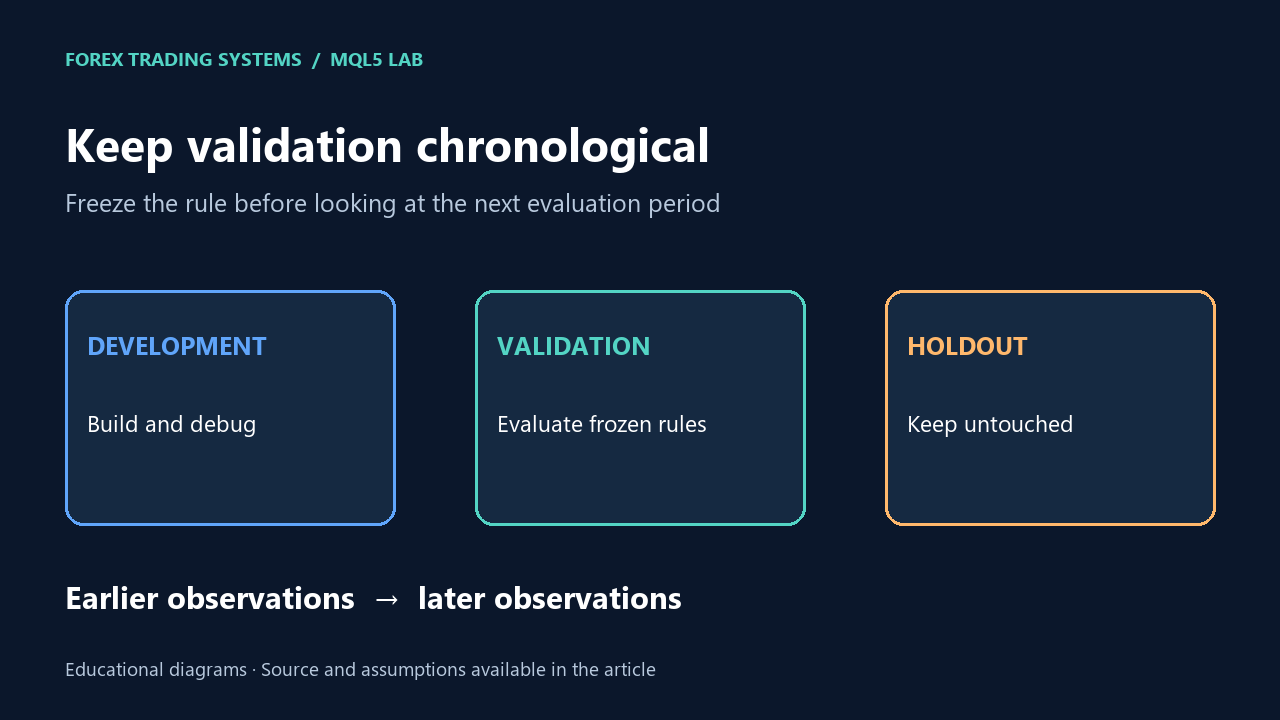
Use an earlier period for development. Freeze the rule and inputs before evaluating a later validation period. Keep a final holdout untouched until the chosen procedure is fixed. There is no universal split percentage: the dates should fit the available history, number of observations and intended market regimes.
If you repeatedly adjust the system after looking at a validation result, that period has become development data. A walk-forward procedure can repeat chronological training and evaluation, but its selection process must also be specified in advance.
4. Measure the effect of searching
Retain the number of parameter combinations tried, not only the winning set. Look for stable neighboring settings rather than an isolated peak. Add adverse cost assumptions and slightly shifted start dates. A few favorable trades can dominate a small sample.
Report trade count, exposure time, equity drawdown, loss sequences and sensitivity alongside returns. A single profit-factor value does not describe execution reliability or the uncertainty in a small sample.
5. Test operational and market stress separately
- Market stress: gaps, wider spreads, changed costs and adverse sequences.
- Specification stress: different volume steps, minimum sizes, stop levels and account currency.
- Operational stress: initialization delays, rejected modifications, restart and uncertain responses.
Some operational behavior requires controlled demo observation or a dedicated harness; a normal historical run may not reproduce it. Label simulated assumptions and observed behavior separately.
6. State what the evidence supports
Save a short conclusion explaining what worked, what failed and which assumptions remain untested. Demo execution can provide further behavioral evidence, but cannot guarantee future live results. If you modify the rule, version it and repeat the affected checks.
Our source package currently provides educational examples reviewed against documentation. It contains no published compiled-terminal verification or performance backtest.
References: MT5 Strategy Tester settings, MQL5 testing behavior.

[…] full example is FtsClosedBarMAEA.mq5. Continue with validation after verifying the signal […]
[…] precheck helps explain a request; it cannot guarantee the broker will accept it. Continue with the validation checklist and keep execution behavior separate from strategy […]
[…] specifications. Follow the order-error guide when the broker rejects volume or stops, and use the validation checklist to record the […]