Indicators & Tools

Transparent custom indicators and MT5 diagnostics. Learn calculation timing, indexing and broker specifications before evaluating a trading rule.

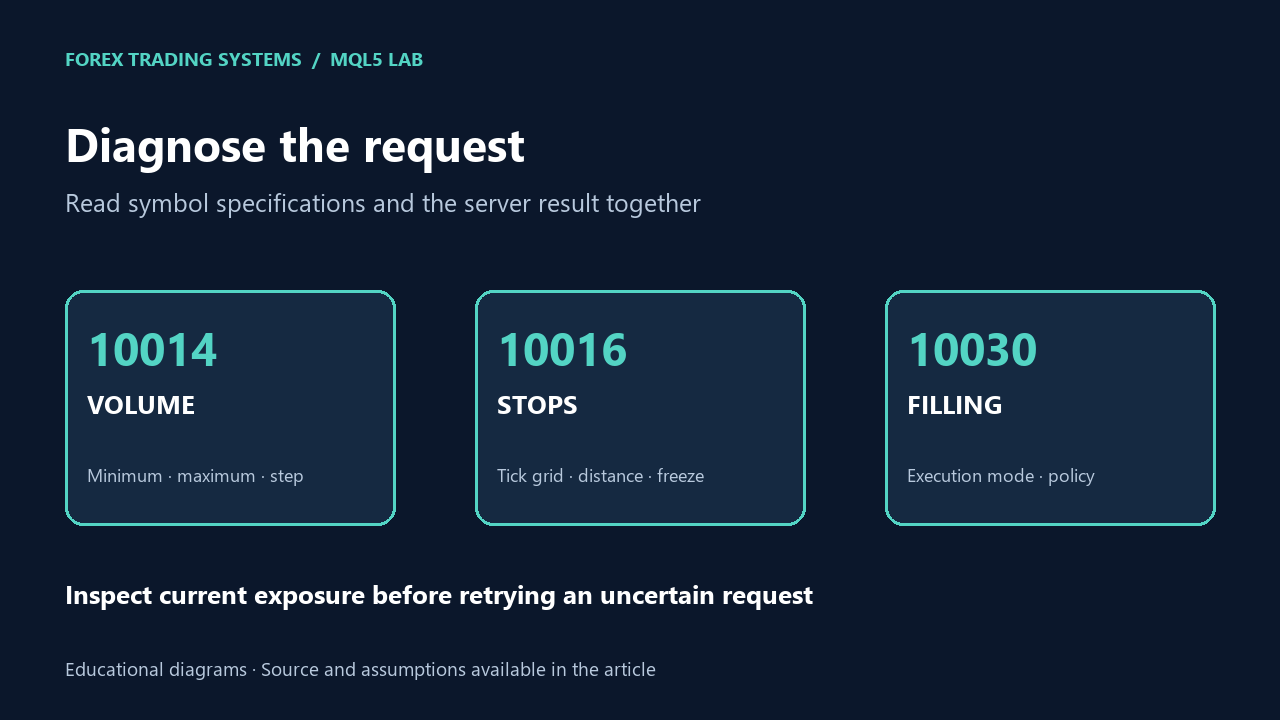
MT5 Order Errors 10014, 10016 and 10030: Volume, Stops and Filling

MT5 Order Errors 10014, 10016 and 10030: Volume, Stops and Filling

Technical revision: 1 October 2026 · Educational materialOn this pageRead the server result10014: invalid volume10016: invalid stops10030: invalid fillingRun a read-only trade diagnosticUse a repeatable debugging sequenceWhen a trade request fails, inspect the server return code and the request values together. A generic “order failed” message hides whether the issue is volume, protective prices, execution policy or something else. Blind retries can create a new problem if the original response was uncertain. Read the server result CTrade method returns and ResultRetcode describe different layers. Log the method result, numeric server code, its description, symbol, requested volume and prices. A request…

Read More
How to Write a Custom MQL5 Indicator with Consistent Buffer Indexing

How to Write a Custom MQL5 Indicator with Consistent Buffer Indexing

Technical revision: 1 October 2026 · Educational materialOn this pageDefine the output and its unitsChoose one array conventionComplete indicator sourceWarm-up, updates and history changesVerify the numbers before interpreting the shapeA useful first custom indicator is the distance between a closing price and its simple moving average. It exposes the central implementation problem: every input array, output buffer and loop must agree on the direction of time. Define the output and its units For each bar, calculate the average of that bar's close and the preceding N-1 closes. Output close - average. A positive value means the close is above its…
Read More
Five Useful MT5 Indicator Types: What to Measure Before You Choose

Five Useful MT5 Indicator Types: What to Measure Before You Choose

Technical revision: 1 October 2026 · Educational materialOn this page1. Trend and moving-average distance2. Volatility tools such as ATR3. Momentum oscillators4. Channel and range tools5. Session and spread diagnosticsEvaluate a candidate with a small comparisonAn indicator is a way to transform observations. Before selecting one, write down the question it should answer. A colorful chart or a product name is not evidence that the output improves your strategy. This guide compares five useful types of tools without ranking unnamed commercial products. 1. Trend and moving-average distance A moving average summarizes recent prices; the difference between price and the average measures…
Read More